
Grease traps
Household and industrial
About grease traps:
Grease trap is designed for trapping oil and grease, which are found in wastewater as a by-product of food processing, in order to prevent blockage of sewer system.
If grease gets into drainage system it causes mechanical issue ‑ sewer blockage and sanitary ‑ foul smell. Additionally, presence of oils, grease and starches in wastewater worsen sedimentary properties of sludge. Grease traps cannot be used for dumping of toilet and bathroom wastewater.
Advantage of grease trap:
- simple installation of parts which is realized at site of specific object;
- the polypropylene material makes it resistant to acids and aggressive liquids;
- simple operation
- lightweight
- equipped with a lid, which blocks unpleasant smells.
Description:
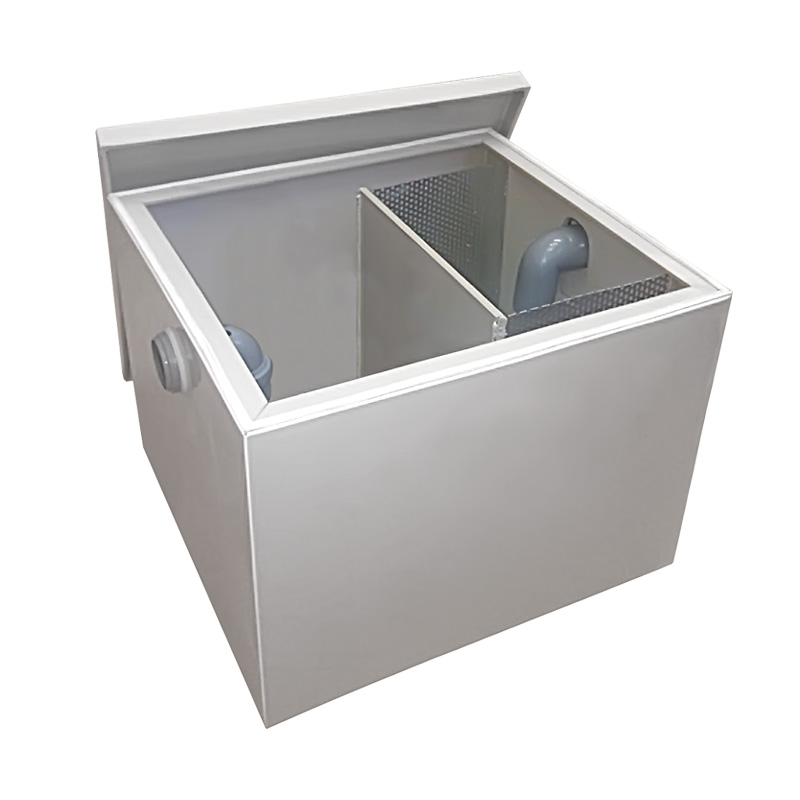
Grease trap has rectangular or cylindrical shape. Inside, it is split into technological chambers.
Operation principle : the grease-containing wastewater flow into fir chamber of grease trap, where sedimentation of suspended particles occurs, after that all separated grease rises to surface layer. The wastewater separated from grease and suspended solid enter second chamber of grease trap, where additional grease separation occurs, and only after this stage the wastewater is dumped into sewer system Далі очищені від жирів та зважених речовин стічні води надходять до другого відсік. The separated grease is stored in grease collector, and after some time it is removed from grease trap. Owing to special construction of grease trap and its lid, the smell does not leave the trap.
Types:
- self-carrying (for concreting );
- non self-carrying ;
- industrial;
- household.
Application fields:
- restaurant ;
- cafe;
- bars;
- fast-food kitchens;
- pre-packaged food workshops;
- meat and dairy industries;
- canned foot plants;
- fish processing plants;
- meat market, slaughterhouses, processing workshops;
- creameries.
Photo gallery:

Product's documents:
 |
Passport |
|
Material safety certificate |
|
Material certificate |
Answers to frequently asked questions: